
L. D’ANGELO, L’Isottèo di Gabriele d’Annunzio e la poetica della modernità, in AA. VV., Un’operosa stagione. Studi offerti a Gianni Oliva, Carabba, 2018, pp. 515- 522.
La poetica della modernità trova nell’Isottèo di Gabriele D’Annunzio la sua più limpida rappresentazione. La raccolta, nata dalla riedizione dell’Isaotta Guttadàuro ed altre poesie, vuole essere la risposta dell’uomo di cultura che sceglie la “forma” alla rappresentazione della vita, e che antepone l’artificio, l’Arte, la letteratura alla vita stessa. Nei versi dell’Isottèo vi è già l’Andrea Sperelli del Piacere, vi è già la teorizzazione di un estetismo evasivo e decorativo, l’ideale dell’arte per l’arte, il dramma dell’uomo moderno.
ISBN: 9788863445466
L. D’ANGELO, Gabriele D’Annunzio e le case della memoria, in «Studi Medievali e Moderni», Memories and Reminiscences”. Ricordi, lettere, diari e memorialistica dai Rossetti al Decadentismo europeo, Atti del Convegno internazionale di studi, Chieti- Vasto, 20-21 novembre, 2019, pp. 363-373.
International Peer-Rewiewed Journal. ANVUR Fascia A (settori 10/F1, F2, F3, F4)
ISSN 1593-0947
The materialization of D’Annunzio’s house offers an important contribution to the study of the writer’s memory, especially for the complex of Vittoriale, D’Annunzio’ s last house. As a monument and museum, poet’s house contains not just the expression of the writer’s ideas and ambitions, but becomes a medium of remembrance, an autobiographical heritage such as literary productions.The creative process and the building of monuments are the same. As already for the esthete Andrea Sperelli, the house is revelation of poet’s soul, here, the vocation to life “as a work of Art” finds its perpetual realization.
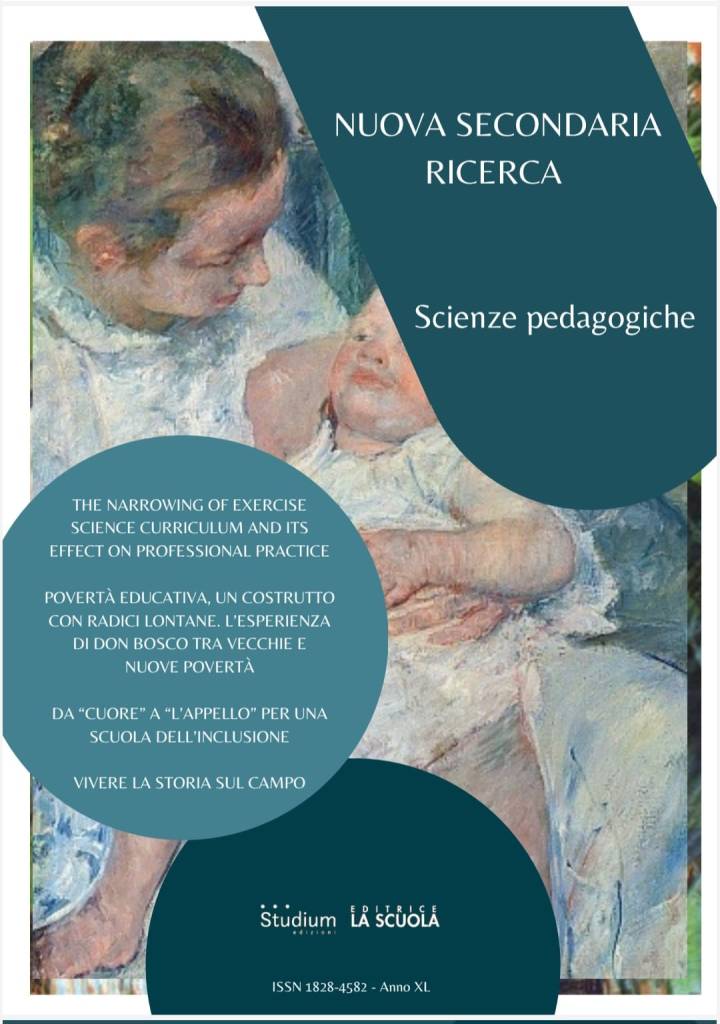
L. D’ANGELO, Da “Cuore” a “L’ appello” per una scuola dell’inclusione, in «Nuova Secondaria Ricerca», n. 8, aprile, 2023.
ISSN: 1828-4582
The theme of inclusion in the school environment is increasingly defined in the name of a conquest of civilization. The paper aims to summarize the main phases that led to Italy on a regulatory and methodological level from the Deamicisian School to that of Inclusion, through literaries references such as Cuore by Edmondo De Amicis and The appeal by Alessandro D’Avenia.
L.D’ANGELO, La Prima antologia di poeti dialettali molisani di Emilio Ambrogio Paterno, in «Letteratura e dialetti», Anno 16, Fabrizio Serra Editore, Pisa, 2023.
DOI: 10.19272/202330701015 ANVUR: A.
The dialect literature of Molise has been always published in collective anthologies. The poet Emilio Ambrogio Paterno, editor of the volume Prima antologia di poeti dialettali molisani (Arte della Stampa, Pescara, 1967) has the merit of having published the first anthology of poetry written in the dialect of Molise; this volume at the same time filled an identity and editorial gap and set the beginning of Molise’s literature.
L. D’ANGELO, Invenzione e ritrovamento: l’illusione del sogno ne ‘L’Isottèo’ di Gabriele D’Annunzio, in «Metaphorica- Rivista di poesia», 5/2024, Edizioni Efesto.

L. D’ANGELO, Music and Soul: Gabriele D’Annunzio and his Abruzzo Homeland, in «Bridges Across Cultures», Proceedings, Vasto, 2017.
ISBN: 978-1-7344509-1-0
Select Conferences proceedings in collaboration with Voces Del Caribe ISSN: 2169-6179 In Il Fuoco (The Flame), D’Annunzio writes, “Have you ever considered that the essence of music might not be in sounds at all? It is in the silence that precedes sound and the silence that follows. Rhythm appears and comes to life in those periods of silence. Every sound and every chord awakens a voice in the silence that can only be heard by our minds. Rhythm is the heart of music, but its beat cannot be heard except during the pauses between sounds.” [1] The silence as the essence of music, music that originates from the inner spiritual human life, through the experience of senses and affections, becoming a voice of mind and soul.
L.D’ANGELO, L’etica dell’acqua di Giuseppe Manitta (Avagliano editore, 2021), in «Gradiva, International Journal of Italian Poetry», n.62 , 2022, ed. Olschki, Firenze
ISSN: 0363-8057
International Journal of Italian Poetry
Rivista internazionale di poesia e poetologia In L’etica dell’acqua Manitta compie un viaggio lirico attraverso quelle topografie della modernità che sanciscono per l’io la perdita di una forma originaria, fino a proclamare la propria inconsistenza all’interno di un divenire che scorre, e che è materia fluida, cangiante: vale a dire, la nostra contemporaneità
L. D’ANGELO, Dante tra Web e Social Network, in «Studi Medievali e Moderni», XXV, 1-2, 2021.
International Peer-Rewiewed Journal. ANVUR Fascia A (settori 10/F1, F2, F3, F4)
ISSN 1593-0947
The celebrations for the Seventh Centenary of Dante Alighieri’s death, in association with the covid-19 health emergency and the pandemic situation, accentuate a trend already in use for several years, as interartistic and interdisciplinary: the search for new expressive and informative ways, first of all the web and social networks, and the new forms of reinterpretation of Dante’s figure, referring to a pop culture and evasive and consumer products, define Dantism as a universal phenomenon, which confirms the centrality of the Poet in the Ages.

L.D’ANGELO, Prefazione, in E.GRANDESSO, Gli altri vedono il clown, Campanotto Editore, Udine, 2025.
Gli altri vedono il clown è un’opera dove la volontà di rappresentazione coincide con una sapiente costruzione narrativa, in cui mascheramento e rivelazione sono in contrapposizione costante. In questi nove racconti, che lo scrittore ambienta in Italia dagli anni Ottanta ai nostri giorni, ci ritroviamo infine reduci dalla pandemia e da quelle grandi e piccole tragedie collettive che sconvolgono ambienti e scenari. Tra l’io e il mondo, colpi di scena e ironia, la società assordante e il suo doppio. Con un finale a sorpresa.
 Laura D'Angelo